
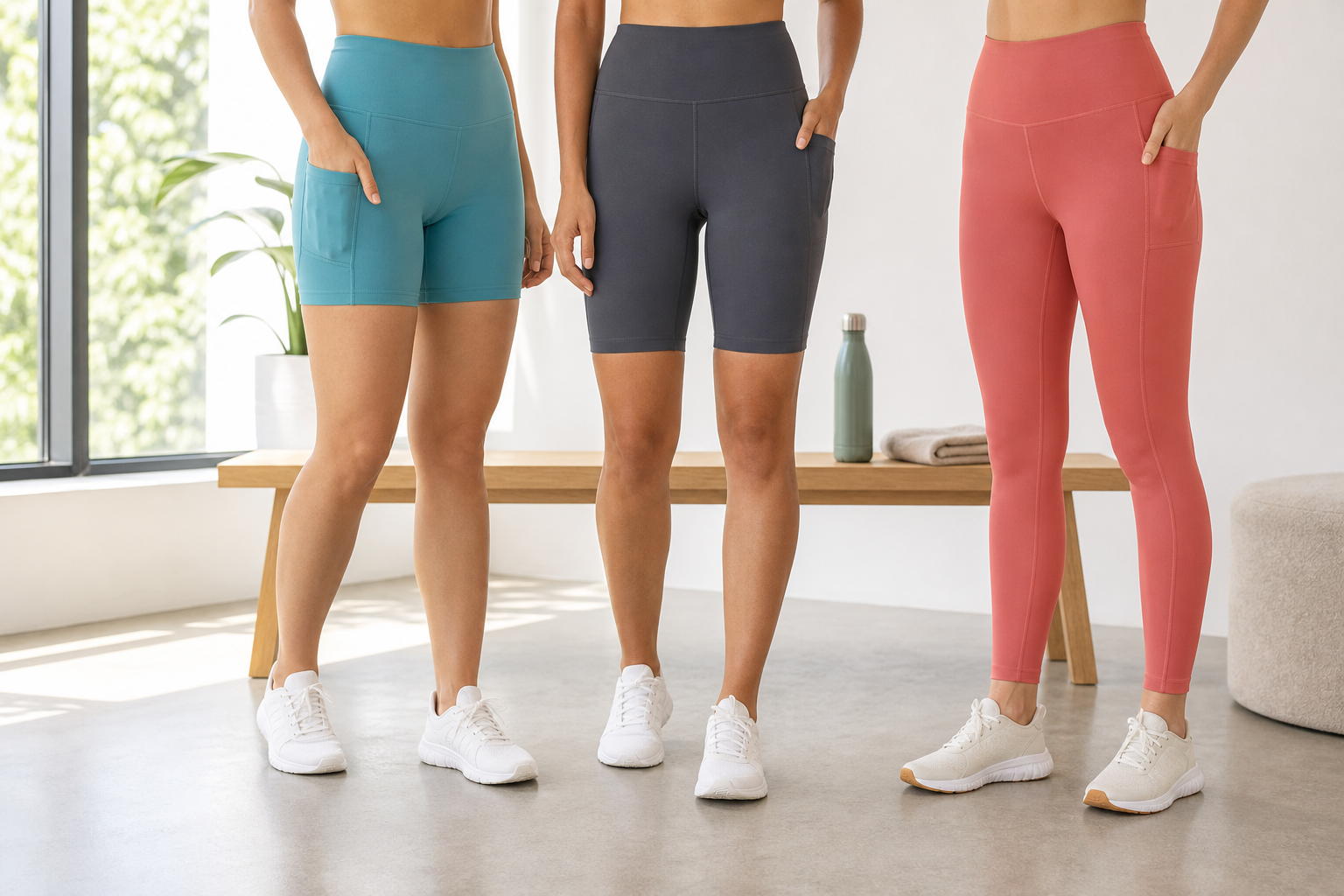
The short answer: choose 6-inch gym shorts when you prefer less leg coverage, 10-inch shorts when you want a longer hem, and 28-inch leggings when full-length coverage suits the activity or setting. Inseam and overall garment length are different measurements, so compare each live size chart with a pair you already own. Then test the waistband, pockets and hem through the movements you actually plan to do.
No length is automatically cooler, safer, more supportive or better for exercise. Weather, fabric, fit, intensity, personal comfort and sun exposure all matter. In very hot or humid conditions, adjust the activity itself rather than expecting clothing to prevent heat illness.
Summer workout bottoms compared
| Style | Useful starting point | Check before ordering |
|---|---|---|
| 6-inch shorts | Less lower-thigh coverage and a shorter silhouette | Inseam definition, ride-up during movement and pocket position |
| 10-inch shorts | More thigh coverage and a longer hem | Whether the hem meets the knee during squats or cycling |
| 28-inch leggings | Full-length coverage and fewer loose hems | Rise, waist fit, garment length and fabric opacity in motion |
1. Compare inseam with inseam
Measure a garment that already fits. Lay shorts flat and measure from the crotch seam to the lower inside hem. For leggings, confirm whether “28-inch” refers to inseam, a style name or another listing convention. Measure from the crotch seam down the inner leg and compare the same points.
My Comfy Fit currently lists Gym Shorts 6" With Pockets and Gym Shorts 10" With Pockets. Their names communicate a useful length distinction, but shoppers should still read the exact chart and variant because size labels such as Small or Medium do not provide every dimension.
2. Check the rise and waistband under movement
A high-rise description indicates where a waistband is intended to sit, not exactly where it will land on every body. Compare waist and hip measurements with the chart. A waistband should feel secure without sharp pressure, rolling or restricting breathing. Perform a gentle squat, forward fold and seated test in your reference garment.
The High Rise Gym Shorts provide another short option, while the High Rise Training 28" Activewear offers a full-length comparison. Use the individual pages for current fibre, colour and size information; do not transfer one product’s construction claims to another.
3. Treat pockets as a capacity question
A pocket is useful only if it holds the specific item without distorting fit or creating a hard pressure point. Compare pocket opening, depth and placement. A key, card and phone have different shapes and weights. Do a slow movement check before carrying valuables during faster activity.
- Confirm that the live listing actually includes pockets.
- Keep sharp or heavy objects out of stretch pockets.
- Do not assume a pocket is zipped, waterproof or theft-resistant unless stated.
- Use another secure storage method when losing the item would be serious.
4. Test coverage instead of trusting a colour name
Fabric can look different when stretched, wet or viewed under strong light. Product photographs and screen brightness cannot prove opacity for every size, colour or movement. At home, inspect a new garment in normal daylight while bending and stretching before removing tags or wearing it outside, subject to the return policy.
The High Rise Seamless 28" Solids is described as an 80% nylon and 20% spandex style on its current listing. Fibre content can inform a comparison, but it cannot guarantee opacity, temperature regulation or durability. Fit and construction also matter.
5. Plan for heat and sun separately
Health Canada advises planning outdoor activity around heat and checking local forecasts and alerts. On hot days, schedule strenuous activity for cooler periods, take breaks, drink water according to public-health guidance and know the signs of heat illness. Clothing is only one part of that plan.
Shorter hems expose more skin. The Canadian Cancer Society recommends combining shade, clothing, a wide-brimmed hat, sunglasses and broad-spectrum sunscreen for sun protection. Workout leggings should not be described as UV-protective unless the exact product has substantiated testing and the listing makes that claim.
6. Choose by activity and setting
For walking or errands, pocket access and sitting comfort may matter most. For floor work, consider whether seams or pocket contents press against the body. For cycling, check how a shorts hem meets the saddle and whether loose items can fall out. For strength training, prioritize unrestricted bending and a stable waistband. These are fitting checks, not claims that a particular garment improves athletic performance.
7. Read the fibre and care labels
Listings in this catalog use nylon, polyester and spandex in different combinations. Verify the exact product. Canada’s Competition Bureau explains that textile labels provide fibre-content information, while the U.S. Federal Trade Commission’s Care Labeling Rule guidance explains care-instruction responsibilities.
Follow the sewn-in label for washing, drying, bleaching and ironing. Empty pockets, separate colours as directed and avoid extra heat unless permitted. Stretch fabrics and prints may respond differently to heat and abrasion, so there is no responsible universal promise that one routine prevents fading, odour, pilling or loss of stretch.
Five-minute fitting checklist
- Measure the inseam, waist and hip of a garment you like.
- Compare those numbers with the exact product and variant chart.
- Decide how much thigh or leg coverage you want.
- Check waistband comfort while sitting, bending and squatting.
- Test pocket capacity with the item you plan to carry.
- Review opacity in normal daylight and follow the return policy.
- Read the fibre and care labels before washing.
Frequently asked questions
Are 6-inch shorts cooler than 10-inch shorts?
They expose more leg, but comfort in heat also depends on weather, fit, fabric, activity and individual response. No inseam prevents heat illness.
Are 10-inch shorts better for running?
Not universally. A longer hem may provide preferred coverage, while another person may prefer less fabric. Test chafing, ride-up, pockets and movement for your use.
Are full-length leggings too warm for summer?
Not automatically. Conditions and garment construction vary. Adjust outdoor activity for heat and use public-health guidance rather than relying on clothing alone.
Does “seamless” mean there are no seams?
It may describe reduced or specialized seam construction, not an entirely seam-free garment. Inspect the listing and delivered item.
Will a phone stay secure in a side pocket?
Do not assume so. Check depth, opening and movement with the exact phone and case, and use secure storage when needed.
Bottom line
Choose summer workout bottoms by matching measurable length, rise and pocket design to your body, activity and setting. Six-inch shorts reduce coverage, 10-inch shorts extend it, and 28-inch leggings cover the full leg. None is automatically best: the stronger choice is the garment whose size chart, movement test, care label and current listing fit your real routine.